
2JZ Water Pump Delete: The CFD Data Nobody Else Publishes
Most 2JZ water pump delete brackets are never flow tested. Ours is.
We cut the flow restriction through our 2JZ water pump delete bracket by 47% before it went anywhere near a customer's engine. Here is the work.
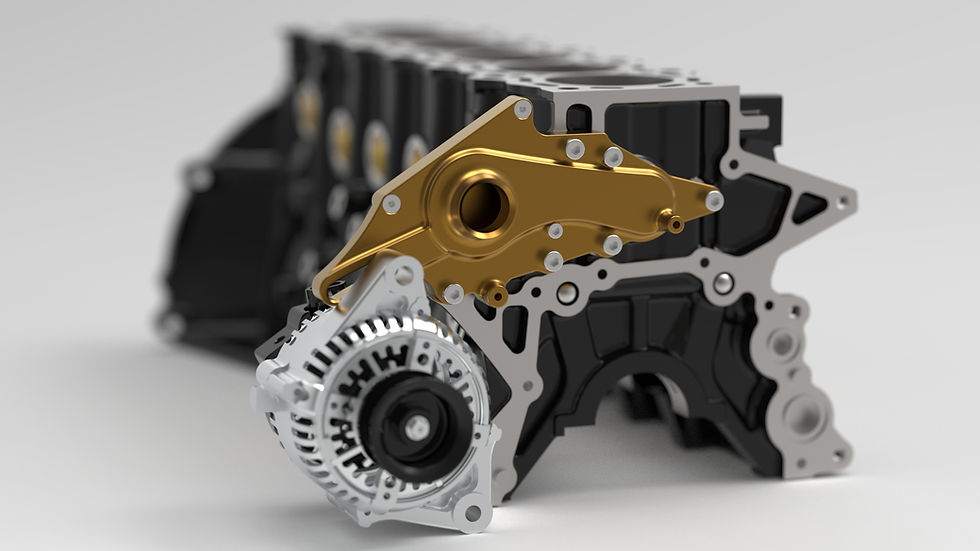
A 2JZ water pump delete removes the belt driven mechanical pump and replaces it with a remote electric pump, using a bracket that blanks the pump housing and routes coolant into the block. On the 1JZ and 2JZ the same part usually carries the alternator, which is why it gets sold as a water inlet alternator bracket. It has to do three jobs at once: seal the block, hold the alternator in position, and flow coolant without choking it.

A water pump delete adapter looks like a simple part. Blank off the mechanical pump, weld or machine a port, feed coolant in from a remote electric pump. Plenty of people sell exactly that.
The problem is what nobody shows you. That adapter is a duct, and every duct costs you pressure. Your electric pump makes a fixed amount of head. Whatever your adapter eats, the block, heads, radiator and hoses never see. You paid for a high flow pump and a restrictive adapter quietly gave the flow back.
So we put ours through CFD in Ansys Discovery before committing to the final geometry. Four flow rates, real coolant properties, total pressure measured across the part. Not marketing numbers. Actual pressure drop in kPa, tracked across three design revisions.
Where we started: 40 m/s through the water pump delete bracket
The first run failed. At 130 L/min the adapter cost 16 kPa, more than double our 7 kPa target, and peak coolant velocity hit 40 m/s.

For context, you want coolant moving at 3 to 5 m/s in a passage this size. 40 m/s is not flow, it is a jet. The streamlines showed exactly why: two chambers joined by a narrow waist, with everything accelerating hard through the middle and the outer volume doing nothing but sitting there.
Baseline numbers across the sweep:
Flow (L/min) | Mass flow (kg/s) | Pressure drop | |
60 | 1.03 | 4.2 kPa | 0.6 psi |
95 | 1.62 | 8.2 kPa | 1.2 psi |
130 | 2.22 | 16.0 kPa | 2.3 psi |
200 | 3.42 | 38.6 kPa | 5.6 psi |
That top figure is the one that mattered. 38.6 kPa is 5.6 psi of pure loss across a part the size of your palm. Run that against a typical remote electric pump and the pump never reaches its rated flow at all. It dead heads against your own adapter.
This is the number nobody publishes, because measuring it means admitting it exists.
How much flow does a Davies Craig EWP150 actually make?
The EWP150 is rated 162 L/min. It will never deliver that in your car, and the manufacturer's own published curve says so.

Davies Craig's EWP150 page lists the headline specs: 162 L/min (42.8 GPM) max flow, 10 A max draw at 13 V, -16 AN ORB inlet and outlet, and a burst pressure of 500 kPa. Davies Craig position it for engines 5.0 L and up, plus modified, turbocharged, supercharged, drag and drift applications, which puts a built 2JZ GTE squarely in its range.
Two of those numbers get misread constantly.
162 L/min is open flow. That is the pump discharging into thin air with zero restriction. The moment you attach a cooling system, it drops. Every pump on the market is advertised this way and it tells you almost nothing about what happens in a real engine.
500 kPa burst pressure is not head. That is the structural rating of the housing before it splits. It is not what the pump produces. Some people see 72.5 psi on a spec sheet and think they have found a monster. They have found a pressure vessel rating.

The curve is where the truth lives. Read the EWP150 line:
Flow | Head available |
0 L/min (shutoff) | 51 kPa |
60 L/min | 40 kPa |
95 L/min | 31 kPa |
130 L/min | 18 kPa |
162 L/min | 0 kPa |
At 130 L/min this pump has 18 kPa of head left. Total. For the entire cooling system.
Now put our original adapter back in the picture. 16 kPa of loss against 18 kPa of available head. The adapter alone would have consumed 89% of everything the pump had, before the block, heads, radiator, thermostat and hoses took a single kPa. The system would have collapsed to a much lower flow and the customer would have blamed the pump.
One more thing worth knowing while you are looking at that chart. The brushed EWP range (80, 115, 140, 150) all sit in a tight band along the bottom. The brushless EWP160 and EWP180 are in a completely different league: the EWP180 makes roughly 100 kPa at 130 L/min against the EWP150's 18 kPa. Over five times the head at the same flow. If you are building for real power, that gap matters more than the model number on the box.
Three revisions, 47% of the restriction gone
We did not redesign the part. We opened up the waist, softened the turns and fixed the internal radii, then re-ran the full sweep each time.

Revision 1 - open the throat. The waist between the two chambers was the entire problem. Enlarging those radii dropped peak velocity from 40 m/s to 10.5 m/s and took 31% off the pressure drop at the design point.
Revision 2 - correct the fluid model. Not a geometry change, but worth stating because it affects every number we quote. Our first runs used default coolant properties at room temperature. Real engine coolant at 90 C is roughly six times less viscous. Running cold properties put the low flow cases in a flow regime that does not exist in a running engine. Fixed, re-run, numbers now honest.
Revision 3 - refine the turns. Further radius work on the entry and exit. Smaller gain, but it took the design point under 9 kPa.
The progression at 130 L/min:
Stage | Pressure drop | vs baseline |
Baseline | 16.0 kPa | - |
Revision 1 | 11.0 kPa | -31% |
Revision 2 | 9.5 kPa | -41% |
Revision 3 (final) | 8.5 kPa | -47% |

Peak velocity in the final design sits around 8 m/s. That is a well behaved coolant passage, not a jet.
The final 2JZ water pump delete bracket, measured against the pump
At a realistic operating point the finished adapter costs 4.8 kPa. That is 15% of the head an EWP150 has available there, and the number is the whole point of the exercise.
With the EWP150's curve and a typical cooling system's resistance, this pump settles somewhere around 85 to 95 L/min on a 2JZ GTE. Not the 162 L/min on the box. Here is how the finished adapter stacks up across the range:
Flow (L/min) | Adapter loss | Pump head available | Adapter's share |
60 | 2.0 kPa | 40 kPa | 5% |
95 | 4.8 kPa | 31 kPa | 15% |
130 | 8.5 kPa | 18 kPa | 47% |
At the flow an EWP150 actually runs, our adapter takes 15% of the available head and hands the rest to the engine. That is what a delete adapter is supposed to do.
The 130 L/min column tells the other half of the story, and it is not about our part. An EWP150 does not have the head to push 130 L/min through a complete cooling system no matter what adapter you bolt on. If that is the flow you want, the pump is your limit. Step up to a brushless EWP160 or EWP180 and the same adapter costs you under 9% of available head at that flow.
Final design specs:
Pressure drop at 95 L/min | 4.8 kPa (0.70 psi) |
Pressure drop at 130 L/min | 8.5 kPa (1.2 psi) |
Peak internal velocity | ~8 m/s |
Simulated fluid | 50% glycol in water at 90 C |
Validated flow range | 60 to 130 L/min |
Which electric water pump should you run on a 1JZ or 2JZ?
Pick the pump for its head curve, not its headline flow number. Then make sure nothing in the plumbing throws that head away.
Three things to take from this:
Ignore open flow ratings. 162 L/min, 55 GPM, whatever is printed on the box - that is the pump discharging into nothing. Ask for the curve. If a manufacturer will not publish one, that tells you something on its own. Davies Craig publish theirs, which is to their credit.
Head is a budget and everything spends it. Adapter, hoses, fittings, radiator, thermostat, the block and heads themselves. A 90 degree fitting costs you. A tight hose bend costs you. An unmeasured adapter can cost you half the budget by itself.
Match the pump to the flow you actually need. A brushed EWP150 is a solid pump for a moderate build. For a high power 2JZ GTE pushing serious heat, the brushless EWP160 or EWP180 is not a luxury, it is the difference between a cooling system that works at sustained load and one that does not.
Our water inlet alternator bracket for the 1JZ and 2JZ is designed and validated to not be the weak link in that chain. -16 AN ORB to match the pump, flow path developed in CFD rather than guessed, alternator mounting retained, and every number on this page measured rather than claimed. If you are running a 2JZ water pump delete, the bracket should be the part you stop thinking about.

Frequently asked questions
What is a 2JZ water pump delete?
A 2JZ water pump delete removes the belt driven mechanical water pump and replaces it with a remote electric pump. A bracket blanks off the pump housing and routes coolant into the block. On the 1JZ and 2JZ this bracket normally also carries the alternator, which is why it is often listed as a water inlet alternator bracket.
Do you need a water pump delete on a 2JZ?
No, not for a standard build. The factory pump is adequate for most power levels. A water pump delete makes sense when you want to free the parasitic belt load, control coolant flow independently of engine speed, keep coolant circulating after shutdown, or clear space at the front of the engine.
How much flow does a 2JZ actually need?
It depends on the pump you fit. Our testing found a Davies Craig EWP150 settles at roughly 85 to 95 L/min in a complete cooling system, well short of its 162 L/min open flow rating. A brushless EWP160 or EWP180 will support meaningfully higher flow because it makes far more head.
What is the pressure drop through your 2JZ water pump delete bracket?
4.8 kPa (0.70 psi) at 95 L/min, and 8.5 kPa (1.2 psi) at 130 L/min, simulated with 50% glycol in water at 90 C. Peak internal coolant velocity is around 8 m/s.
Why does open flow rating not tell you what a pump will do?
Open flow is measured with the pump discharging into free air at zero restriction. Once it is connected to a cooling system, back pressure reduces flow along the pump's head curve. A pump rated 162 L/min open may deliver closer to 90 L/min installed. Always read the head curve rather than the headline number.
Is burst pressure the same as pump pressure?
No. Burst pressure is the structural rating of the pump housing before it fails. The EWP150 is rated 500 kPa burst but produces roughly 51 kPa of head at shutoff and 18 kPa at 130 L/min. The two figures are unrelated.
Does this bracket fit the 1JZ as well as the 2JZ?
Yes. The water inlet alternator bracket is made for both the 1JZ and 2JZ.
Sources
Davies Craig EWP150 Black Remote Electric Water Pump (#8165) - specifications and published EWP flow curves
CFD performed in Ansys Discovery. Steady state, isothermal, 50% glycol in water at 90 C (density 1010 kg/m³, viscosity 0.001 Pa·s). Total pressure measured across the bracket inlet and outlet planes at four mass flow rates.

Comments