
Why We Killed the Stock JZ Oil Pan
Updated: Sep 9
The factory oil pan on a 1JZ or 2JZ has been unchanged for over three decades. Stamped steel, a thin RTV silicone seal, a restrictive OEM pickup, and just enough oil capacity to get you through a Sunday commute. That was fine in 1991. It is not fine in 2026, when half the JZ engines still on the road are making two to three times their factory power and getting driven like they owe someone money.
We didn't build the Ichiban Billet Rear Sump Oil Pan because it looked cool on a shelf. We built it because we were tired of watching good engines die from a problem that has nothing to do with the block, the head, or the tune - and everything to do with a fifty-cent stamped steel pan that can't keep oil where it needs to be when the car is actually being driven hard.

The Problem: Oil Starvation Doesn't Care About Your Build Sheet
Here's the reality nobody puts in their build thread. You can drop a built bottom end, forged internals, a fresh set of bearings, and a big single turbo into a JZ - and still grenade the motor because the oil pickup sucked air for half a second going into a corner. Under hard cornering, braking, or sustained high-G acceleration, oil in the factory pan sloshes away from the pickup. No baffle. No trap door. No backup plan. Just a thin steel pickup tube hoping the oil stays where it's supposed to be.
That's oil starvation, and it is one of the single most common - and most preventable - causes of catastrophic bearing failure in built JZ engines. The factory pan was never designed for track use, drift use, or anything above stock power and stock driving inputs. It was designed to be cheap to stamp out by the thousands.
On top of that, the OEM pan holds a stock oil volume with almost no thermal mass and no cooling surface area. Push the car hard for more than one session and oil temps climb fast, viscosity breaks down, and you're back to the same starvation problem from a different angle.
We looked at this and asked a simple question: why is anyone still running a fifty-cent stamped steel pan under a $15,000+ built engine? So we didn't.
The Design Process: Solving It in CAD Before We Touched a Single Block of Aluminum
Every Ichiban part starts in CAD, and the rear sump pan was no exception - except this one took longer than most, because a pan isn't just a container. It's a system: pan geometry, baffle placement, pickup location, and drain path all have to work together under G-loads in every direction, not just sitting still on a bench.
We modeled the OEM sump cavity first to understand exactly where oil pools and where it escapes to under lateral and longitudinal G-force. From there we built an internal baffle system with trap doors - one-way gates that let oil flow toward the pickup basket but block it from surging away during hard cornering or braking. This isn't a flat plate with holes drilled in it like some of the "upgrade" baffles floating around. It's a directional system designed around how oil actually behaves in a sump under real driving loads.

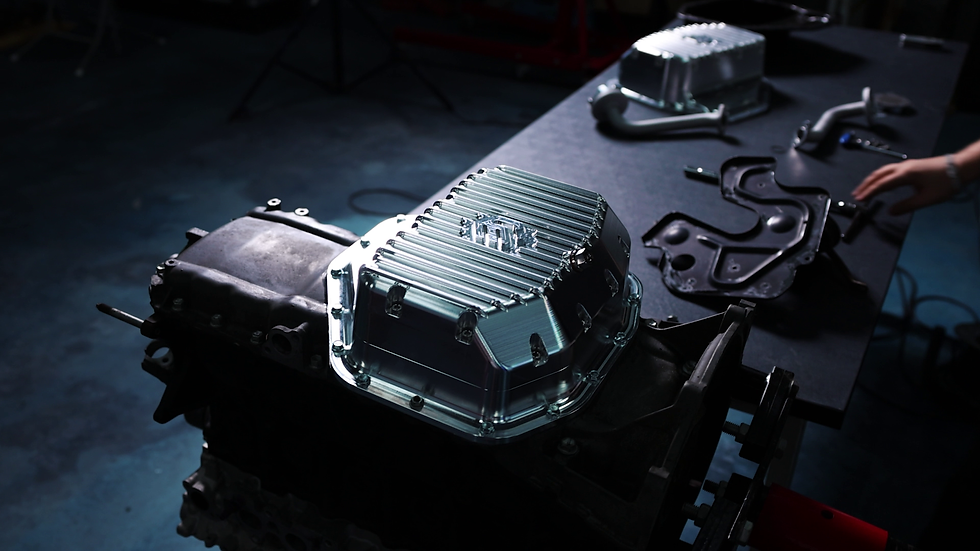
We increased internal volume to add a full 1.5 liters of capacity over the OEM pan - more oil, more thermal mass, more time before temperatures and viscosity become a problem. Then we finned the exterior of the billet body itself, turning the pan into a secondary heat exchanger instead of just a container that happens to hold oil.
The oil pickup went through its own separate design cycle. We modeled it as a lightweight, extended pickup and 3D printed it in AlSi10Mg aluminum to keep weight down while holding up to sump temperatures and pressures without deforming. Every revision got test-fitted against the CAD sump geometry before we committed to a final pickup length and inlet position.

We also made the decision early that this would be a two-piece, serviceable pan - not a sealed or welded unit. If you ever need to clean it out, inspect the baffle, or replace the O-ring, you open it. You don't cut it open or throw it away.
Manufacturing: Aerospace-Grade Billet 2JZ Oil Pan, Not Stamped Sheet Metal
Once the design was locked, this pan is CNC machined from 6061-T6 aluminum billet - the same aerospace-grade material we use across our valve covers and intake manifolds. No casting, no stamping, no thin sheet metal that dents the first time a rock kicks up off the track. Billet means the wall thickness, the baffle geometry, and the mounting surfaces are exactly what we designed in CAD, every single time, part after part.
The two-piece design seals with a machined O-ring groove instead of a bead of RTV silicone. RTV works fine on a stock engine that never gets opened. It is not what you want on a track car where thermal cycling and repeated servicing are the norm - O-rings don't shrink, crack, or squeeze out under heat cycling the way silicone does.

Every pan ships with a titanium Grade 5 magnetic drain plug. Titanium because it's stronger and lighter than the steel drain plug Toyota gave you in 1991. Magnetic because it catches metal debris in your oil before it becomes a bearing's problem instead of the pan's problem.
The Result: Near Dry-Sump Reliability Without Dry-Sump Money or Complexity
What comes out the other end is a complete kit - pan, baffle plate, basket, pickup assembly, and titanium drain plug - that bolts on as a direct replacement and gives you a level of oil control that used to require a full dry-sump conversion, at a fraction of the cost and zero of the complexity. No external tank, no scavenge pumps, no extra plumbing to package around your chassis. Just a smarter pan doing a dry-sump's job.
+1.5L of additional capacity. A finned billet body that actually sheds heat instead of just holding oil. A trap-door baffle system that keeps oil at the pickup under sustained cornering and braking loads instead of letting it slosh away at the worst possible moment. A 3D printed lightweight pickup tube built specifically around this pan's geometry, not adapted from a generic parts bin part. Machined from 6061-T6 billet instead of stamped steel. Sealed with an O-ring instead of silicone. Serviceable instead of disposable.
This is what we mean when we say we design parts to solve a real failure point, not to fill a catalog slot. If your JZ is making real power, seeing real track time, or getting driven anywhere near its limit, the factory pan is the weak link in a chain you probably spent thousands of dollars strengthening everywhere else. We built this pan so it stops being the reason your build ends early.
Available raw machined or anodized in any color at no extra cost. Lead time is approximately 3 weeks.
Comments